Books
Chris’ story of his dramatic and challenging experience in healthcare is important work.
- Texas Governor Rick Perry
- Texas Governor Rick Perry
I don’t know why Americans aren’t in the streets with pitchforks over their healthcare.
- CEO, Major American Healthcare Company
- CEO, Major American Healthcare Company
Chris’s story will be on the commencement circuit.
- Dr. Kirsten Novak, Stanford University
- Dr. Kirsten Novak, Stanford University
Chris is a resilient and inspiring man who survived an utterly horrific experience."
- Captain Ann Gibson, US Army, Black Hawk Pilot. CEO, Adventure Wellness
- Captain Ann Gibson, US Army, Black Hawk Pilot. CEO, Adventure Wellness
Few people understand the healthcare ecosystem and the determinants of health as intimately.
- Michael Uhl, CEO, Halo Diagnostics
- Michael Uhl, CEO, Halo Diagnostics
Chris is a survivor who gives people hope and strength to continue living their life after devastating loss.
- Reuters Editor, Suicide Campaigner
- Reuters Editor, Suicide Campaigner
No one in this country should have their life so thoroughly and needlessly destroyed by our healthcare system. We know it happens all the time."
- Dr. Edward Weise
- Dr. Edward Weise
Chris is a voice for those who have none, and discussing issues that need to be talked about."
- Pulmonologist, Boulder, Colorado
- Pulmonologist, Boulder, Colorado
I really have no idea how Chris continued living with such profound and sustained losses.
- Lisa Stegman, Psychotherapist and Grief Practitioner
- Lisa Stegman, Psychotherapist and Grief Practitioner
The Perimeter Trilogy (2028)
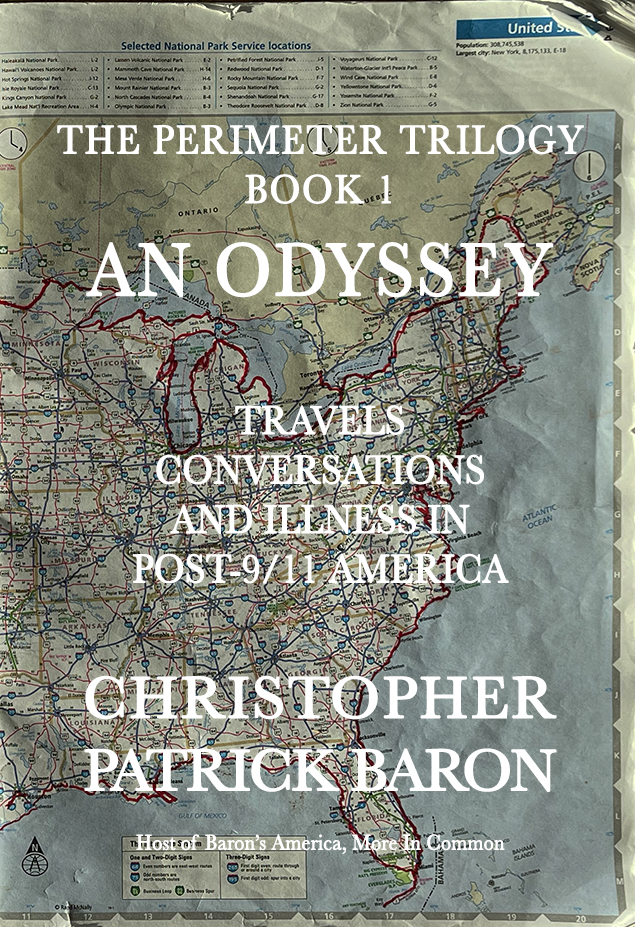
BOOK 1: PERIMETER, AN ODYSSEY
A rare view of America during one of the most pivotal periods in her history
In this expansive look at a post-9/11 America, Baron combines photos and words from his multi-year circumnavigation and interviews with hundreds of Americans along his route and those he met while embedded in cities across the country. As a former investigative journalist and political reporter, he undertook what would become a year’s long, De Tocqueville-esque examination of the country, during which he saw the forces that created the world in which we live and the complex challenges and unlimited opportunities that reside at the edges of our polarized society. Baron paints a compelling and sobering portrait of a divided country.
A rare and intimate view of the post-9/11, Great Recession era. In the waning days of the Great Recession, Baron began a multi-year, 20,000-mile circumnavigation of the U.S., speaking with over 1,000 Americans and spending months embedded in cities across the country. The journey was elongated by difficult-to-diagnose health issues, providing him with a rare opportunity to learn from his own experience, the many healthcare professionals he met, and the people he encountered along the way. He completed his journey during the 2025 election.
A rare and intimate view of the post-9/11, Great Recession era. In the waning days of the Great Recession, Baron began a multi-year, 20,000-mile circumnavigation of the U.S., speaking with over 1,000 Americans and spending months embedded in cities across the country. The journey was elongated by difficult-to-diagnose health issues, providing him with a rare opportunity to learn from his own experience, the many healthcare professionals he met, and the people he encountered along the way. He completed his journey during the 2025 election.
Excerpt
In the lingering days of the Great Recession, approximately halfway through our 20-year Global War on Terror, I embarked on a multi-year examination of post-9/11 America, reminiscent of De Tocqueville's travels in 1831 that resulted in his book Democracy in America.
I began my journey when, after an early career as an investigative journalist and political reporter, I simply did not recognize so much of what I was seeing in my country. Challenges that seemingly had solutions persisted, wages remained flat in some sectors, the gulf between the college educated and those who were not grew, the hints of what would become today’s homeless crisis were visible, and politics, always a blood sport, began a transition to theater. Reaching across the aisle became punching across the aisle. Perhaps foremost was a perception that government and institutions were less often crafting solutions than prescribing the equivalent of, “take an aspirin and see me at the next election.”
It seemed the best way to understand the underlying forces at play was to follow in the footsteps of numerous writers and thinkers who came before me—hitting the road and conversing with ordinary Americans. I drew a thick red marker line around the edge of the continental United States on an old Rand McNally map - the perimeter — a visually striking and diverse route that symbolized a nation brimming with opportunities and facing formidable risks.
Over a decade I chipped away at a circumnavigation of the United States, traveling tens of thousands of miles, spending months at a time embedded in cities across the country, and speaking with well over 1,000 Americans.
I bore witness to the questioning and dissolution of many traditional social structures, the destabilizing effect of technology on every domain of life, a concentration of wealth not seen since the gilded age, and an escalating political polarization that that grew stronger with every election cycle, forcing a wedge between families, friends, and neighbors. Among my most pivotal observations was the effect technology companies, venture capital, and hedge funds were having on our cultural and social fabric. With each exit and the resulting new multi-millionaires, Silicon Valley’s impact became endemic in our lives not just via devices, but via the impact of wealth flowing to other cities, where the same dynamics occurred: gentrification, increasing real estate prices and rents, strained infrastructure, and destabilization of neighborhoods, families, and local businesses.
Personally, I could never have predicted how my own life would veer far too close to the very issues I set out to understand.
I began my journey when, after an early career as an investigative journalist and political reporter, I simply did not recognize so much of what I was seeing in my country. Challenges that seemingly had solutions persisted, wages remained flat in some sectors, the gulf between the college educated and those who were not grew, the hints of what would become today’s homeless crisis were visible, and politics, always a blood sport, began a transition to theater. Reaching across the aisle became punching across the aisle. Perhaps foremost was a perception that government and institutions were less often crafting solutions than prescribing the equivalent of, “take an aspirin and see me at the next election.”
It seemed the best way to understand the underlying forces at play was to follow in the footsteps of numerous writers and thinkers who came before me—hitting the road and conversing with ordinary Americans. I drew a thick red marker line around the edge of the continental United States on an old Rand McNally map - the perimeter — a visually striking and diverse route that symbolized a nation brimming with opportunities and facing formidable risks.
Over a decade I chipped away at a circumnavigation of the United States, traveling tens of thousands of miles, spending months at a time embedded in cities across the country, and speaking with well over 1,000 Americans.
I bore witness to the questioning and dissolution of many traditional social structures, the destabilizing effect of technology on every domain of life, a concentration of wealth not seen since the gilded age, and an escalating political polarization that that grew stronger with every election cycle, forcing a wedge between families, friends, and neighbors. Among my most pivotal observations was the effect technology companies, venture capital, and hedge funds were having on our cultural and social fabric. With each exit and the resulting new multi-millionaires, Silicon Valley’s impact became endemic in our lives not just via devices, but via the impact of wealth flowing to other cities, where the same dynamics occurred: gentrification, increasing real estate prices and rents, strained infrastructure, and destabilization of neighborhoods, families, and local businesses.
Personally, I could never have predicted how my own life would veer far too close to the very issues I set out to understand.
BOOK 2: MY MAGICAL YEAR
A profound and inspiring exploration
of tenacity, hope, and healing
Baron describes his return to Aspen, Colorado just prior to the pandemic, and his subsequent recovery from a series of life altering health events and losses that left him near death. In unrelenting pain and emotionally and physically exhausted, he describes a tenacious will to not only survive but to thrive, succeeding in a world of boutique medicine, world class surgeons, pain specialists, physical therapists, and Olympic athletes.
In 2018, he returned to Aspen, Colorado to focus on his health. He wrote a manifesto about meaning, purpose, and a life worth living, and dedicated himself to regaining his strength—spending months in the backcountry hiking, on horseback, in the gym, swimming in alpine lakes, practicing marathon meditation, and working with a team of talented physical therapists. The unique methodology he developed addresses the totality of our humanness and draws from spirituality, psychology, philosophy, and neuroscience.
In 2018, he returned to Aspen, Colorado to focus on his health. He wrote a manifesto about meaning, purpose, and a life worth living, and dedicated himself to regaining his strength—spending months in the backcountry hiking, on horseback, in the gym, swimming in alpine lakes, practicing marathon meditation, and working with a team of talented physical therapists. The unique methodology he developed addresses the totality of our humanness and draws from spirituality, psychology, philosophy, and neuroscience.
Excerpt
The spectacular alpine wilderness near his home became a sanctuary where under cerulean blue skies and in frigid whiteout snow storms he found solace and strength on cold water swims, day long hikes, skiing, and horseback riding. And in a valley soon to rise even higher on the list of the world’s most expensive zip codes, he found genuine community, friendship, and rebirth. A manual on resilience, navigating loss, and holding on to hope when there seems to be none, Baron has written a treatise on surviving tragedy and crafting a mid-life renaissance and a life of meaning, purpose, and joy.
BOOK 3: TRAVELS IN THE FAR NORTH